
Accounts receivable cycle: what it is and how to optimize yours.
The accounts receivable cycle is the complete process that a credit transaction goes through within a company, from the moment of the sale on credit to the actual receipt of payment. Understanding and optimizing this cycle is fundamental for CFOs and financial managers who seek to reduce delinquency, improve working capital, and make data-driven decisions.
In this article, we detail each stage of the receivables cycle, identify the most common bottlenecks, and present practical strategies to optimize the entire process.

What is the accounts receivable cycle?
The accounts receivable cycle represents the financial journey of each receivable within the company. It begins with the granting of credit, when the company decides to sell on credit, and ends when the amount is actually credited to the account.
The shorter the cycle, the faster the capital returns to the company. The longer the cycle, the more time the money remains "stuck" in accounts receivable, directly impacting cash flow and investment capacity.
For companies operating with tight margins or relying on working capital to maintain operations, the accounts receivable cycle is as important an indicator as gross revenue. It's pointless to bill R$ 10 million if R$ 3 million are tied up in receivables that are 90 days overdue.
The 6 Stages of the Accounts Receivable Cycle
The accounts receivable cycle can be divided into six distinct stages, each with its own risks and opportunities for optimization.
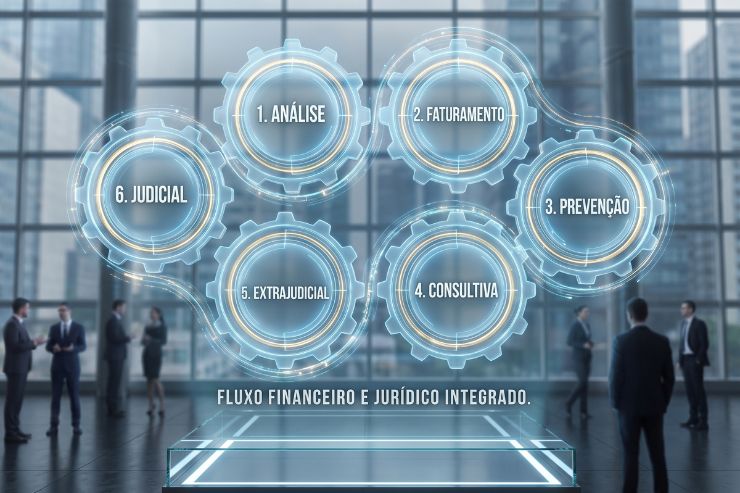
Step 1: Credit analysis and approval
It all begins with the decision to sell on credit. At this stage, the company assesses the buyer's profile, checking credit score, payment history, financial capacity, and business references.
The most common mistake at this stage is approving credit without proper analysis, driven by the pressure to close sales. The result is predictable: default in the medium term. Credit scoring and B2B risk analysis tools allow you to automate this assessment and set credit limits proportional to the risk.
Step 2: Invoicing and issuing invoices
After approval, the company issues the invoice and the corresponding document, whether it's a bank slip, a duplicate invoice, or another credit instrument. At this stage, operational errors such as incorrect registration data, poorly configured due dates, or unregistered bank slips generate rework and unnecessary delays.
Automating billing, integrated with the ERP and banking systems, eliminates most of these problems. Registered payment slips are automatically distributed via DDA (Direct Debit Authorization), ensuring that the payer receives the notification in their online banking.
Step 3: Preventive management (pre-expiration)
The 15 days leading up to the due date are critical. Preventive actions during this period, such as sending reminders via SMS, email, or WhatsApp with the updated payment slip, can significantly reduce delinquency.
Preventive asset management (PAM) is a methodology that operates within this time frame, using personalized communications to ensure the client is aware of the due date and has all the means to make the payment. This consultative approach preserves the relationship and demonstrates professional organization.
Step 4: Consultative collection (1 to 30 days overdue)
When a due date passes without payment, the consultative phase begins. The goal here is not to pressure, but to understand the reason for the delay. The client may have faced a temporary cash flow problem, may have forgotten, or may be questioning some aspect of the product or service.
The consultative contact, usually by phone or WhatsApp, seeks to identify the root cause and propose quick solutions. Often, simply resending the updated invoice or offering a new deadline for payment is enough.
Step 5: Extrajudicial collection (31 to 180 days)
After 31 days of delay, the collection process becomes more assertive. Specialized teams use multi-channel approaches, such as calls, WhatsApp, SMS, email, direct debit authorization (DDA), and, in some cases, notification of inclusion in delinquent debtor registries, to negotiate payment.
This is the stage where many companies choose to outsource debt collection to a specialized agency. The reason is clear: agencies have dedicated infrastructure, trained negotiators, and segmentation tools that significantly increase the recovery rate.
Stage 6: Judicial reorganization (over 180 days)
When all amicable attempts are exhausted, the only remaining option is legal action. Protest of promissory notes, collection actions, and enforcement of guarantees are legal instruments used to recover high-value debts or from habitual debtors.
Legal action is more time-consuming and costly, but necessary in certain situations. Specialized legal teams in debt recovery credits They conduct the process with a focus on efficiency and the preservation of documentary evidence.

Indicators for monitoring the accounts receivable cycle
Financial managers should regularly monitor the following indicators to assess the health of the accounts receivable cycle.
THE Average Collection Period (ACP) It measures how many days, on average, the company takes to receive payment after invoicing. The lower the average collection period (ACP), the better the financial health. An increasing ACP is a warning sign.
THE Default Rate It calculates the percentage of overdue accounts receivable relative to total receivables. The target varies by sector, but rates above 5% already warrant immediate attention.
THE Aging Report (The aging report) segments receivables by delinquency range — due, 1-30 days, 31-60 days, 61-90 days, and over 90 days. This view allows for the identification of risk concentrations and proactive action.
THE Recovery Rate It measures the percentage of overdue debts that are actually recovered. It is the definitive indicator of the effectiveness of the collection operation.
How to optimize your company's accounts receivable cycle.
There are five practical actions that have a direct impact on optimizing the accounts receivable cycle.
The first one is Automate the billing process., This ensures that each payment delay bracket receives the appropriate treatment without relying on manual actions. Collection management platforms integrated with ERP and banking systems enable this automation with low implementation costs.
The second one is Investing in credit analysis for lending. Preventing default is cheaper than recovering from it. B2B scoring and risk analysis tools should be part of the installment sales approval process.

The third is diversify collection channels. Email, SMS, WhatsApp, DDA (Direct Debit Authorization), phone call, and self-service negotiation portal—each channel reaches a different profile of defaulter. The intelligent combination multiplies the contact rate.
The fourth is Segment the portfolio by risk profile.. Treating all defaulters the same way is a waste of resources. High-value accounts, strategic clients, and habitual debtors require different approaches.
The fifth is outsourcing at the right time. When internal collections reach their limit (usually between 60 and 90 days), a specialized consultancy with a success-based remuneration model can recover credits that the company had already considered lost.
Accounts receivable cycle and the company's financial health.
The accounts receivable cycle is directly connected to working capital. When receivables are slow to come in, the company needs to seek other sources of financing, such as loans, receivables financing, and invoice discounting, which have financial costs.

In a scenario of high interest rates, such as the one Brazil will face in 2026, this cost is even more relevant. Each additional day in the receivables cycle represents money that could be earning interest or being reinvested in the operation.
Therefore, optimizing the accounts receivable cycle is not just a task for the finance department; it's a business competitiveness strategy.
THE Way Back He is an expert in accounts receivable management. more than 30 years, offering [preventive and corrective solutions] For companies of all sizes and sectors. Talk to us and discover how to optimize your results.